User Interface (With High Availability Mode)

Written by B3Networks Academy
Updated at June 17th, 2026
-
OSS/BSS Answers
Access Control Security Hub Admin Audit B3Network Master Account Channel App Contract App Customer App Discount App Edge Server File Management Finance App Invoice App Number Management Payment Portal Settings Price List Product App Release V2 SMS Gateway Supplier App Support Center Support Hub Business Hub Sales Hub Finance Hub
- App Model - Organization Management
- App Model - Communication Apps Answers
- License Model - Organization Management
-
License Model - CPaaS Solution Answers
Phone System - Admin Guide Phone System - End-user Guide Mobile App Desktop App Web Phone Omni-Channel Auto Attendant - Admin Guide Developer Hub - Admin Guide Microsoft Teams Operator Connect - Admin Guide Microsoft Teams Direct Routing - Admin Guide Contact Center - Supervisor Guide Contact Center - Agent Guide SIP Trunk CPaaS - SIP Trunk Power SIP Trunk CPaaS Fax CPaaS Hotdesking Contact Campaign File Explorer Power Mobile App Files App Campaign App Data Compliance
- Telcoflow
- Integrations Answers
- Updated Regulations
- Ideas Portal
Table of Contents
Overview
High Availability (HA) creates a secondary SIP account that handles calls when the primary account is unavailable. HA is a paid add-on to the SIP Trunk subscription.
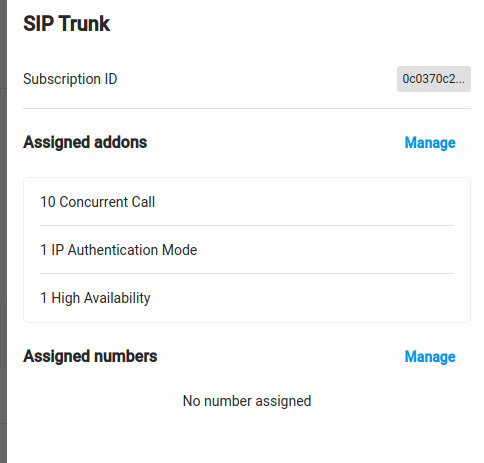
Requirement: Purchase the High Availability and IP Authentication Mode add-on
HA Modes
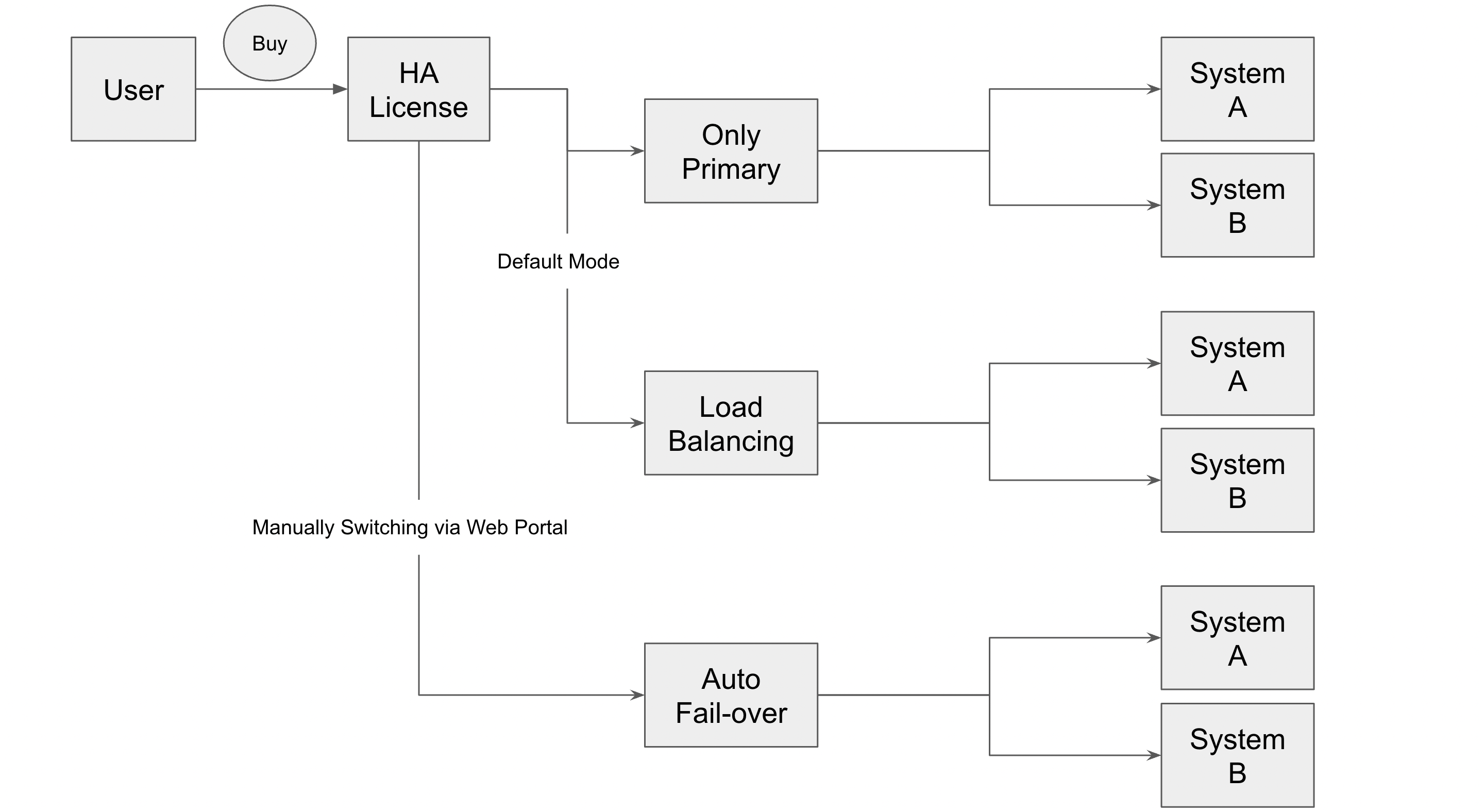
Modes are available :
- High Availability
- High Availability 2T
- High Availability 4T
- High Availability 2T and 4T
High Availability (There is tab High Availability):
High availability enables your system to operate continuously without interruption for a designated period of time and ensures that it meets an agreed-upon level of operational performance.
There are 3 modes:
- Only Primary: all calls use the Primary SIP account.
- Load Balacancing
- Auto Fail-over
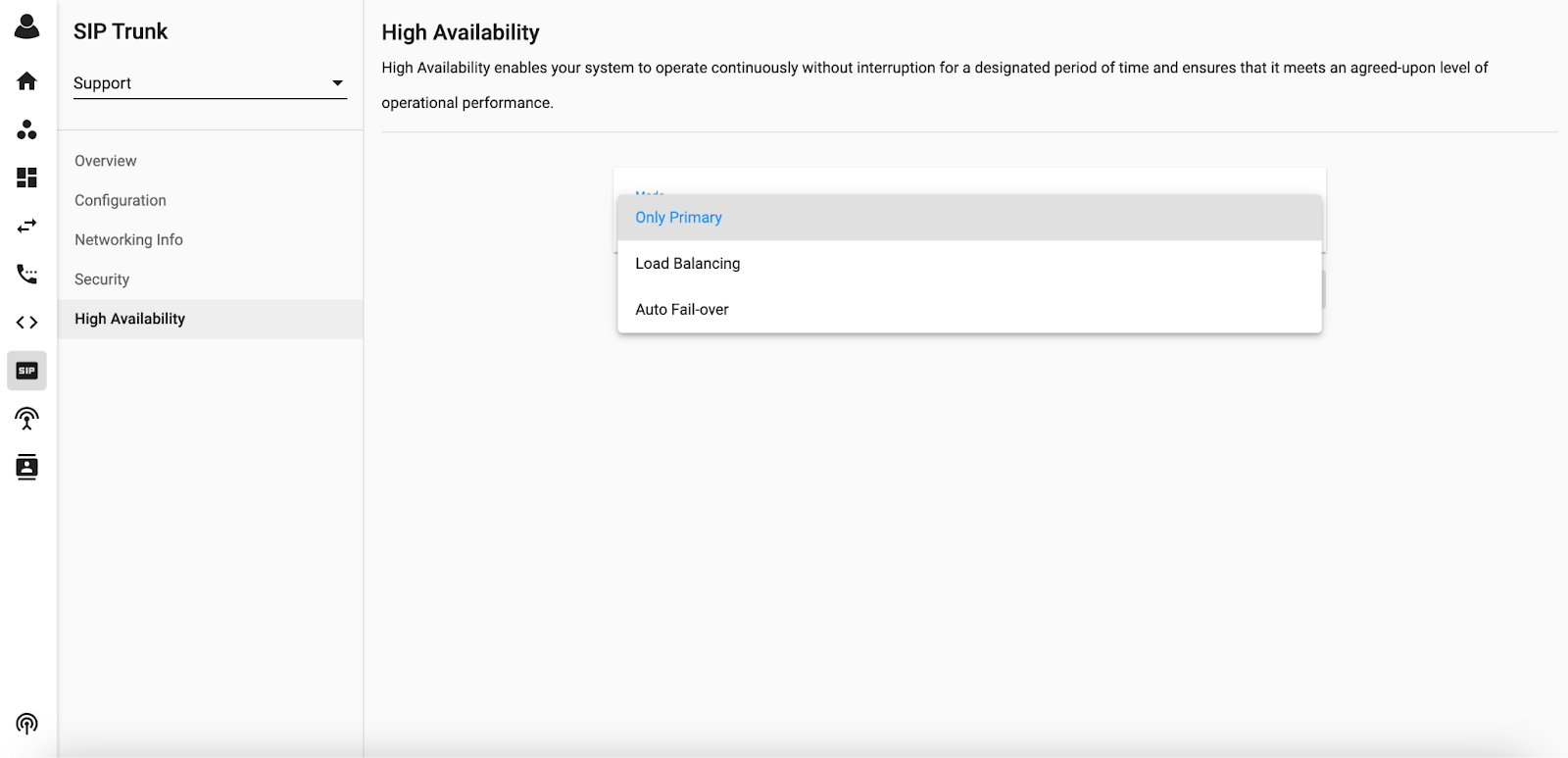
Mode 1: Only Primary (Default)
- All calls use the Primary SIP account. The secondary account exists but receives no traffic.
Mode 2: Load Balancing
- Distributes calls between the Primary and Secondary SIP accounts in round-robin order.

Behaviour:
- Distributes incoming call traffic in round-robin between both SIP accounts.
- Does not check whether either SIP account is registered — routes regardless of status. No automatic retry if a call fails.
- Primary and Secondary accounts share the same concurrent call pool.
- Outbound caller ID follows the Primary account's settings.
Mode 3: Auto Failover
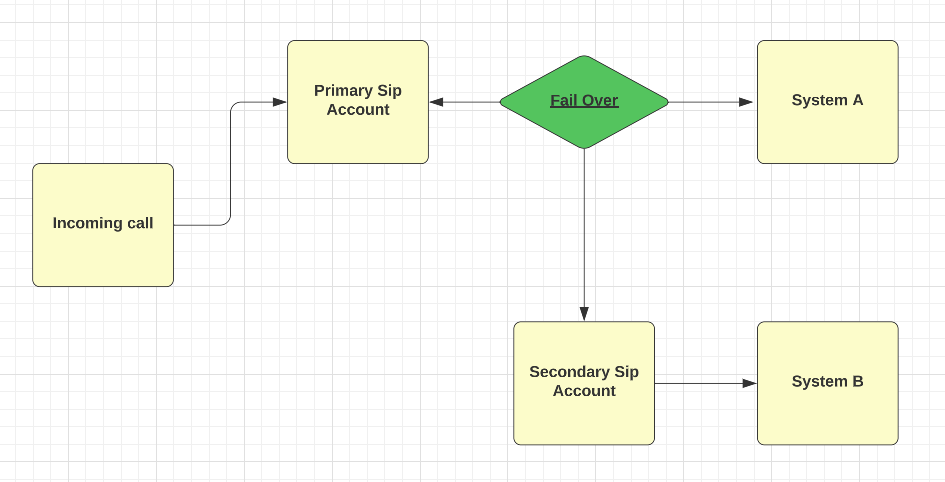
Routes calls to the Secondary SIP account when a specific failure condition is detected on the Primary. The system evaluates each call outcome to determine whether failover should be triggered.
Failover trigger rule: Failover is only triggered for far-end failure conditions — specific SIP response errors and connection failures from the remote end. Client-side issues and authentication errors do not trigger failover.
Conditions that trigger failover (Failover = TRUE)
| SIP Response Code | Cause |
|---|---|
| 408 | No answer |
| 480 | No answer |
| 500 | Far-end response error |
| 501 | Far-end response error |
| 502 | Far-end response error |
| 503 | Far-end response error |
| 504 | Far-end response error |
| 505 | Far-end response error |
| 513 | Far-end response error |
| 580 | Far-end response error |
| N/A | Far-end connection error (primary unreachable at network level) |
Conditions that do NOT trigger failover (Failover = FALSE)
| Condition | Reason |
|---|---|
| 401 / 407 | Authentication-related errors — not a far-end failure |
| USER_NOT_REGISTERED | Client-side issue — registration has lapsed |
| Other 4xx | Not a far-end failure |
| Other 5xx | Not explicitly supported for failover |
| 603 | Call rejected — deliberate response, not a failure |
| 6xx | Global failure responses |
Failover time: 2.5 seconds from the point of failure detection.
Both accounts share the same concurrent call pool. Total simultaneous calls cannot exceed the allocated limit on the Primary account.
Secondary SIP Account Configuration
Configure the secondary account under Configuration → Secondary Region tab:
| Setting | Description |
|---|---|
| SIP Label | Display name for the secondary account. |
| Authentication Mode | Account (Digest) or IP Authentication — can differ from the primary. |
| IP Whitelist | Trusted IP addresses for the secondary account. |
| Transport protocol | TCP, UDP, or TLS. |
SIP Label
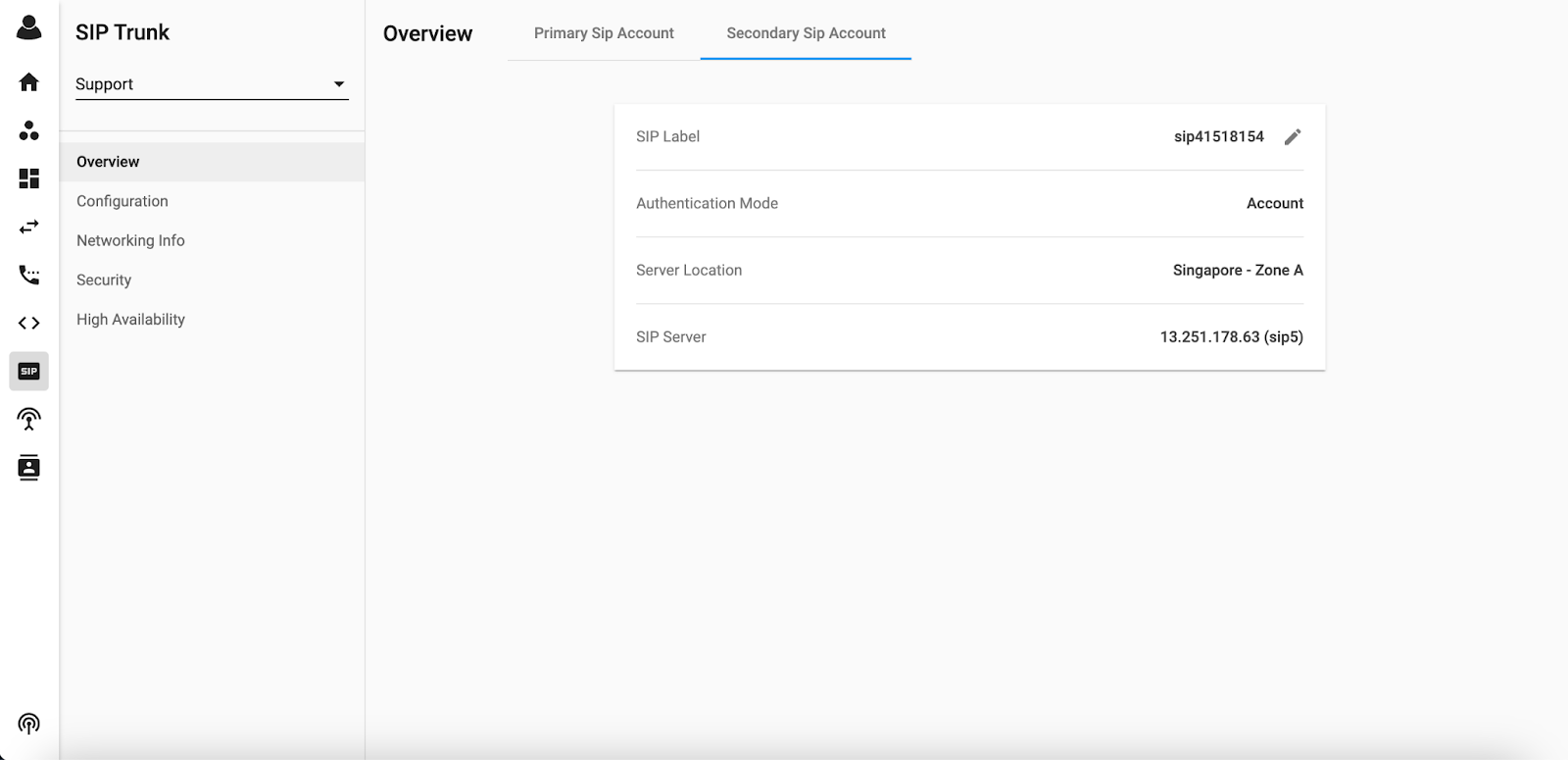
Authentication Mode

IP Address List

Advanced HA — 2T and 4T
Advanced HA extends redundancy across multiple availability zones and regions.
| Configuration | Architecture | Behaviour |
|---|---|---|
| HA 2T |
1 region, 2 zones  |
Round-robin between 2 zones within the same region. If one zone fails, all traffic moves to the other.
|
| HA 4T |
2 regions, 1 zone each  |
All calls go to the primary region. Fails over to the secondary region when the primary region is down. |
| HA 2T + 4T |
2 regions, 2 zones each  |
Within a region: fail over between zones. If both zones in a region fail: fail over to the other region. |
Advanced HA is not self-service. Contact B3Networks support to configure 2T or 4T on your account.